
When people talk about internet speed, they usually focus on their internet plan. How many megabits. How many gigabits. How much it costs.
But internet speed on paper is only part of the story.
Internet performance also depends on the physical infrastructure that carries your data from your home to the rest of the world. That infrastructure is built in layers. If one layer is weak, the whole experience suffers.
To understand why internet quality is not the same everywhere, especially in rural communities, it helps to understand three key terms: last mile, middle mile and backbone.
Why internet quality isn't the same everywhere
Two households can both subscribe to Fiber Gig service and have very different experiences. One streams, games and works from home without even a hint of a hiccup. The other deals with frequent slowdowns at night or dropped connections during bad weather.
That difference often comes down to infrastructure, not just the provider's name on the bill.
The internet works as a connected system. It relies on local connections, regional transport networks and national long-distance routes. If any part of that system is outdated, overloaded or poorly designed, performance suffers.
It's also important to remember that much of America's internet infrastructure was built in phases. Some neighborhoods were upgraded recently. Others are still relying on technology installed decades ago. That patchwork history creates uneven performance from one area to the next.
Rural areas feel this the most. Lower population density makes large infrastructure investments more difficult. In some places, parts of the network are downright antiquated. When demand increases from remote work, online learning and streaming, those older systems strain under the pressure.
The three parts of the internet, in a nutshell
Think of the internet like a transportation system. Your data travels from your house, through your town, across regions and eventually to major hubs where content and services live.
Each step along that path matters.
Last mile: the connection to your home
The last mile is the final stretch that connects the broader network directly to your house or business. This is the line that runs down your street and into your building.
It's called the last mile even if it's only a few hundred feet. It simply means the final segment before your internet connection reaches you.
Every video call, streamed show and uploaded file begins its journey here. If this connection is slow or unstable, everything you do online will reflect that limitation.
Middle mile: how your town connects to the wider internet
The middle mile connects local neighborhoods and towns to major internet hubs. It carries traffic from many last-mile connections and transports it to regional data centers or backbone networks.
If the last mile is your neighborhood road, the middle mile is the highway that connects your town to nearby cities.
This layer often receives less public attention, but it plays a critical role in community-wide performance. When hundreds or thousands of households are online at once, their traffic merges into the middle mile.
Backbone: long-distance internet highways
The backbone is the high-capacity, long-distance infrastructure that carries massive amounts of data across states and countries. It connects major population centers and data centers together.
These are the internet's interstates. They're designed for scale and speed.
Major cloud providers, streaming platforms and enterprise networks depend on backbone routes to move enormous volumes of data every second. Without strong backbone connections, regional networks would struggle to reach the broader internet efficiently.
Why the last mile matters most to everyday users
For most people, the last mile has the biggest impact on day-to-day performance because it's the part you connect to directly.
Different last-mile technologies include:
- Fiber internet
- Cable internet
- Fixed wireless
- Satellite
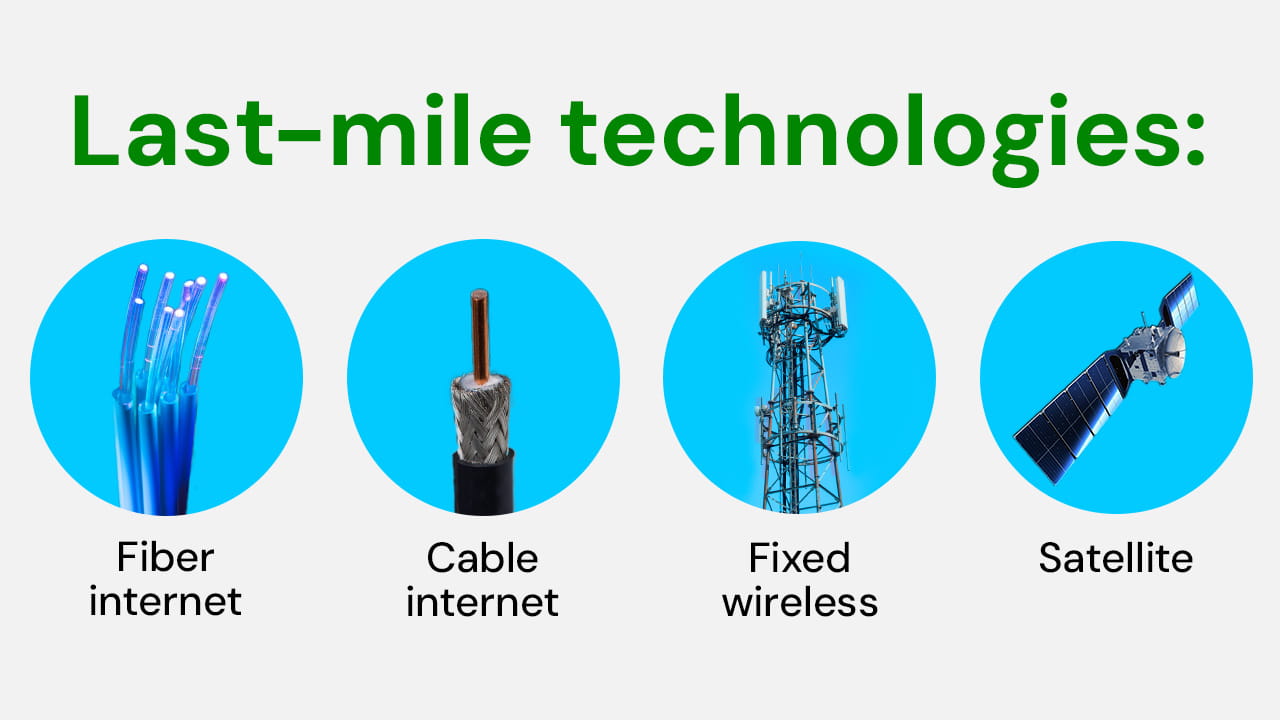
Each one delivers data differently, and that affects speed, reliability and how easily the network can be upgraded over time.
Fiber internet uses strands of glass and light signals to transmit data. It supports extremely high speeds, low latency and symmetrical performance, meaning upload and download speeds can be similar. It's also well positioned for future upgrades because the core material can handle far more capacity than most households use today.
Cable relies on coaxial lines that were originally built for television. It can deliver fast download speeds but often shares bandwidth among neighbors, which can cause slowdowns during peak times. Upload speeds are typically lower than download speeds.
Fixed wireless sends signals through the air from a nearby tower. It can work well in some areas but is sensitive to distance, terrain and interference. Trees, hills and even heavy usage can affect performance.
Satellite connects through orbiting satellites. It can reach remote locations where other technologies can't, but it typically has higher latency and can be affected by weather conditions. Data caps are also common.
If the last mile technology is limited, no backbone in the world can fully compensate for that constraint at your home. The strongest national network cannot overcome a weak connection at your curb. As the saying goes, you're only as strong as your weakest link.
Why the middle mile still matters behind the scenes
Even with a strong last mile connection, your experience still depends on the middle mile.
The middle mile carries traffic from entire communities. If it lacks capacity, congestion can build up when many users are online at once. That can mean slower speeds in the evening, buffering during big live events or inconsistent performance for local businesses.
This is especially important for growing towns. A community might add new housing developments or attract new employers. Without middle mile upgrades, the added demand can stretch existing infrastructure to their breaking point.
Reliable regional networks also matter during outages. A well-designed middle mile can reroute traffic if a line is damaged by construction, weather or accidents. A fragile one can leave entire towns disconnected until repairs are complete.
Why all three must work together for rural broadband
Improving rural broadband is not as simple as upgrading one layer.
Installing fiber internet to homes without strengthening the middle mile can create bottlenecks. Expanding the backbone without investing locally does little for residents if the last mile remains outdated.
In many rural areas, the challenge is cumulative. There may be limited middle mile routes into the region and older last mile technology serving homes. Addressing one piece without the others often leads to frustration.
Each layer supports the others.
Long-term internet quality depends on thoughtful infrastructure planning. Communities need scalable last-mile technology, resilient regional networks and strong connections to national backbones. They also need networks designed with redundancy so a single cut line does not isolate an entire region.
Fixing only one piece may deliver short-term gains. Building all three together creates lasting impact and positions communities for economic growth, remote work and digital services that will continue to evolve.
What this means for consumers and communities
When evaluating internet options, it helps to look beyond advertised speeds.
Better questions to ask include:
- What last-mile technology serves my address?
- Is the network built to scale over time?
- How is the regional network designed to handle growth?
- Are there multiple routes connecting the community to the broader internet?
Availability alone doesn't guarantee long-term performance. An option can be technically available but built on infrastructure that is nearing its limits or difficult to upgrade.
For communities, infrastructure decisions made today can shape economic opportunity for decades. Businesses looking to relocate often evaluate connectivity. Families rely on stable connections for school and work. Healthcare providers depend on secure data transport.
Future-ready networks are designed with capacity, reliability and growth in mind.
Understanding the difference between last mile, middle mile and backbone internet gives you a clearer picture of what you're really buying and what your community is building for the future.