
Aaron Kane is a sales engineer at Ziply Fiber who works with carrier and large enterprise customers on dark fiber, wavelength, Ethernet, EIA and carrier transport solutions. He sat down with us to explain the technical aspects of single-mode fiber and multi-mode fiber for this edition of Translating Tech. If you want to go deep on fiber-optic technicalities, this is for you.
In simple terms, what is single-mode fiber?
Single-mode fiber is the standard type of fiber used in modern telecom and fiber-to-the-home (FTTH) networks. It carries a single path, or “mode,” of light through a very small glass core, which minimizes signal loss and allows data to travel very long distances at extremely high speeds.
It’s the primary type of fiber we use across our network because it supports both long-haul and short-haul applications while maintaining very low signal loss, what we call “attenuation.” Using a single standardized fiber type also simplifies the network design since we don’t have to perform media conversions between different fiber types along the path.
In practical terms, the same single-mode fiber can run all the way from a central office to the customer’s ONT (Optical Network Terminal).
For any serious fiber deployment, single-mode fiber is the standard because it supports much longer distances with far less signal loss.
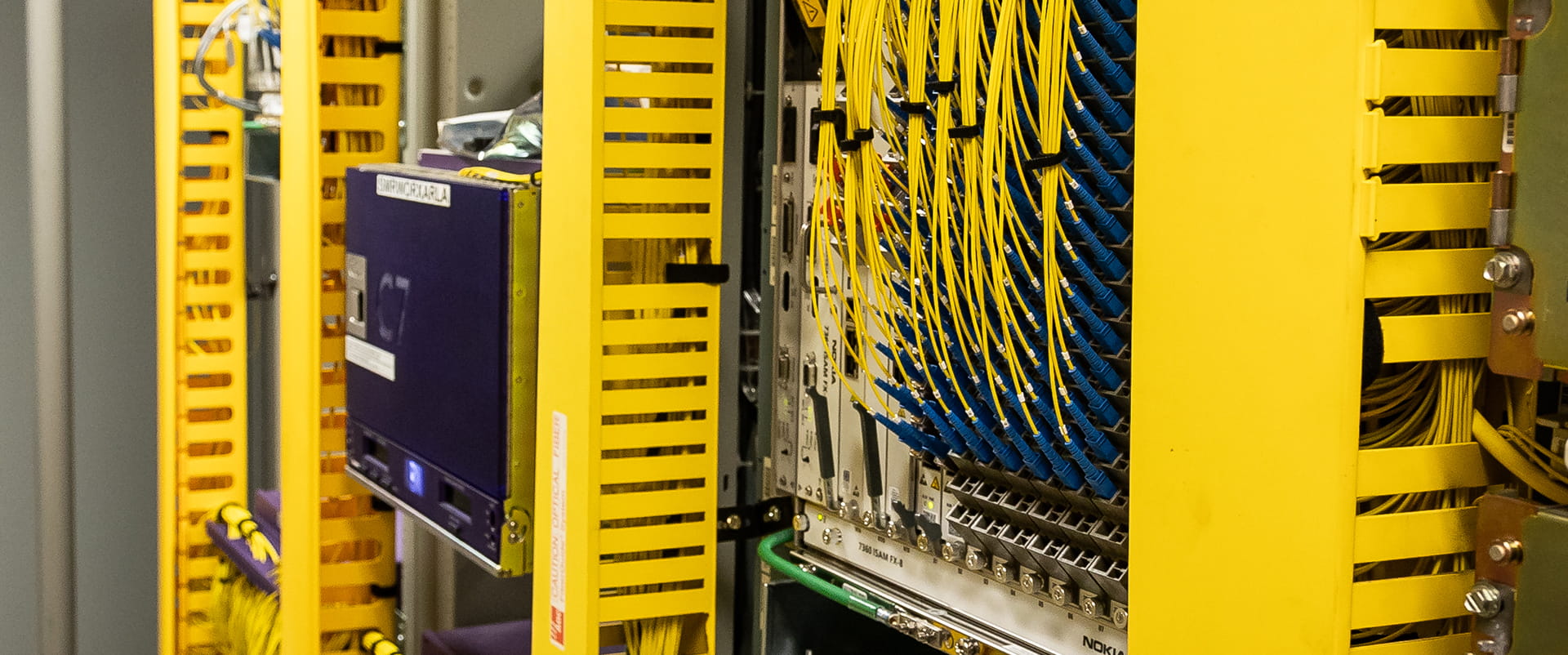
At Ziply Fiber, for example, our entire network plant is single-mode. That allows us to patch fibers directly to customer connections without needing conversion equipment in between. The goal is simple interoperability: connect one jumper on our panel to a jumper on the customer’s panel and establish connectivity without additional electronics. That level of flexibility is only possible when everything is standardized on the same type of fiber.
Now, what is multi-mode fiber?
Historically, multi-mode was much more common when fiber technology was newer. Today, single-mode fiber has become the standard for most real-world network deployments because technology has improved enough to overcome many of the original cost and performance limitations.
Multi-mode fiber mostly exists now because it’s inexpensive. At this point, the main reason to use multi-mode is cost savings for short-distance connections. For example, if you’re connecting one rack to another inside a data center, there’s often no meaningful technical advantage to using single-mode instead of multi-mode. In that case, organizations usually choose whichever option is cheaper.
Multi-mode is mostly used for local-area networking (LAN) applications—situations where connections stay within a single building or private environment. That could be rack-to-rack connections inside data centers, internal business networks, residential structured cabling and apartment buildings. Some newer homes are even built with fiber lines running to individual rooms.
What are the physical differences between single- and multi-mode fiber? How do these modes of fiber work?
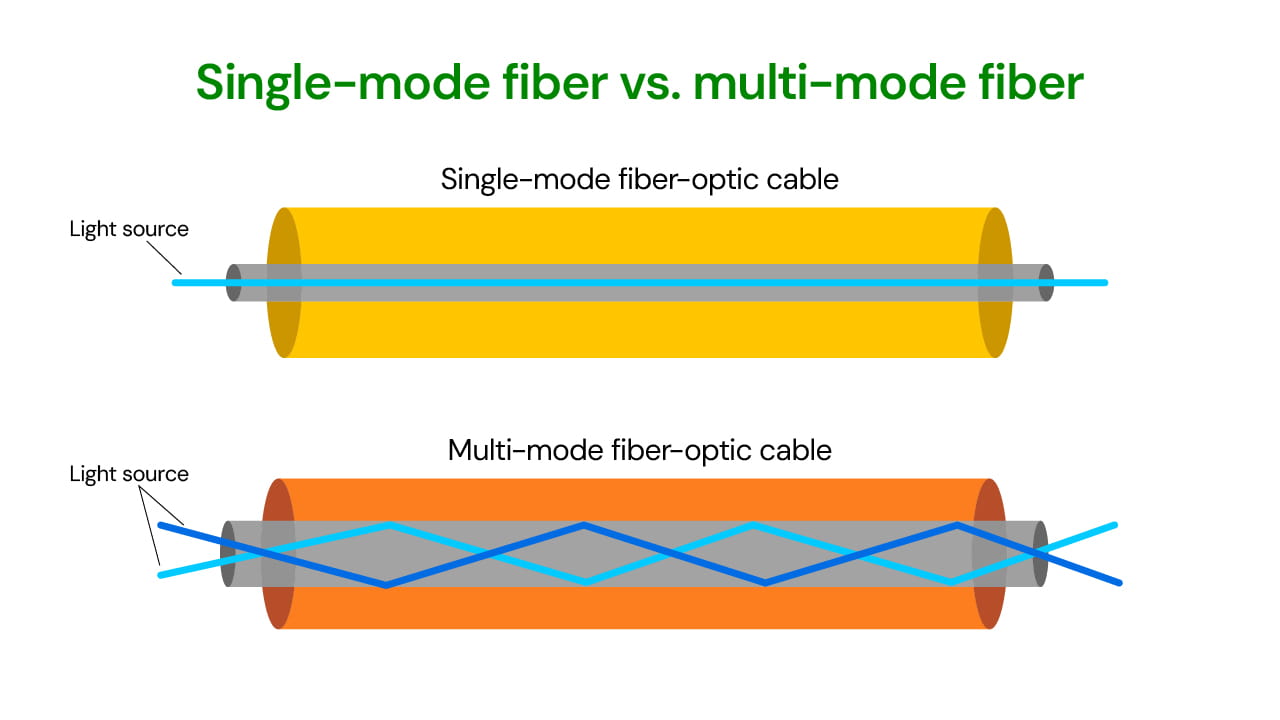
Multi-mode fiber has a much larger core, roughly seven to eight times larger than single-mode fiber. Because the core is larger, you can send multiple spatially separated beams of light through it more easily.
With single-mode fiber, transmitting multiple signals typically requires using different wavelengths—essentially different colors of light—layered together. Specialized equipment on the receiving end separates those wavelengths back out.
That process is more technically complex but allows for much longer transmission distances and significantly greater scalability.
How does single-mode fiber leverage the power of fiber internet over other forms of internet, like cable?
One of the biggest factors to solve is attenuation, or how much optical signal is lost over distance. Every fiber run experiences some signal loss naturally, but higher-quality fiber minimizes that loss. Lower attenuation allows us to reach customers farther away from hubs or central offices and maintain stronger and more reliable optical signals.
We operate on a Passive Optical Network, which is a fiber architecture where there are no powered electronics between the central office and the customer premises. Between those two points, the optical signal is distributed passively through fiber, splitters and other optical components without requiring field power. The benefit of a passive design is lower operational costs, increased reliability, simpler maintenance and greater scalability.
A hybrid fiber-coaxial network—what some cable ISPs call “fiber-powered” internet—uses an active network to power electronics in the field to regenerate, amplify or convert signals. In that architecture, fiber is brought to a neighborhood node, where powered equipment converts and amplifies the signal before distributing it over coaxial cable using DOCSIS technology. Our 100% fiber network doesn’t rely on electricity in the field or need to convert any signals.
How far can each type of fiber run?
Multi-mode fiber is generally limited to about 300–500 meters if you want strong bandwidth performance. Single-mode fiber, by comparison, can carry signals close to 100 kilometers before requiring regeneration or amplification. That distance advantage is one of the primary reasons internet providers overwhelmingly use single-mode fiber.