
By Tom Novotney, VP of Field Operations
If you're over a certain age, you probably remember and may even feel a twinge of nostalgia for the screeching, static-y sound of your desktop computer connecting to the internet. This mid-1990s melody captured a sort of computer-to-computer birdsong: your modem, via the telephone line, made contact with another modem, spurring a brief discussion of which language to speak and which paths to take to connect your computer to the world wide web.
Modem is simply short for "modulator-demodulator." Since everyone knows what that is, we'll move on.
Just kidding. What your dusty, piled-with-cords-in-the-corner modem was doing (and maybe is still doing) was translating analog data to digital data and back again. The modem modulates (codes) data so it can travel out, and it demodulates (decodes) the data coming in.
You can think of it like a translation service. Let's say you go to Japan, but you don't speak a word of Japanese. You hire an interpreter to listen to your restaurant order in English, she translates it into Japanese for the waiter, the waiter understands and replies to the translator, the translator returns to you with his response, and a few minutes later, you're enjoying a tasty platter of sushi. Information out and back. Success. It just took a few steps to get there.
So now you know why your bulky beige computer made those nails-on-a-chalkboard sounds. Those were the early days of consumer internet technology. Within a few years, connectivity via copper phone lines (also known as digital subscriber lines, or DSL) jumped to copper coaxial cable, the same cable used for television. It no longer made so much noise, but modems still did the same job.
Now, in this next era of internet technology, we have fiber internet. Fiber internet operates by transmitting data along thin strands of glass. It can send larger batches of data at higher speeds with better fidelity via pulses of light rather than pulses of electricity. But last we checked, humans couldn't translate pulses of light into useable information. So, we still need something to translate the message out to the information universe and get it back in a language that makes sense.
That's where the ONT comes in. Short for optical network terminal, the ONT serves the same functional purpose as the modem, but it's just translating a different language. That language is light.
Imagine you're 10 years old, it's past bedtime, and you want to get the attention of your friend who lives next door. You grab your flashlight, point it at his window, and turn it on and off in some sequence that you know he understands. He sees it, interprets that it means "let's ride bikes tomorrow," and responds with his own sequence of flashlight pulses that you understand as "yes."
That's basically what the ONT is doing.
Modems and ONTs are similar tools that perform the same job function for different internet technologies. In addition to translating internet "Morse code," they're also talking about which network paths to travel on. In this way, they're also acting like a GPS system to ensure your connection gets to its destination and doesn't end up in gridlock or stuck at a dead-end.
Now, you may be wondering what the router has to do with this. Routers essentially do the same thing, but for another part of the communication process. Routers route data between your device, like your laptop or phone or smart speaker, and the modem or ONT. It translates the information from the modem or ONT into radio frequencies and sends that back to your device. (By the way, many people think WiFi stands for wireless fidelity, but it doesn't mean anything!)
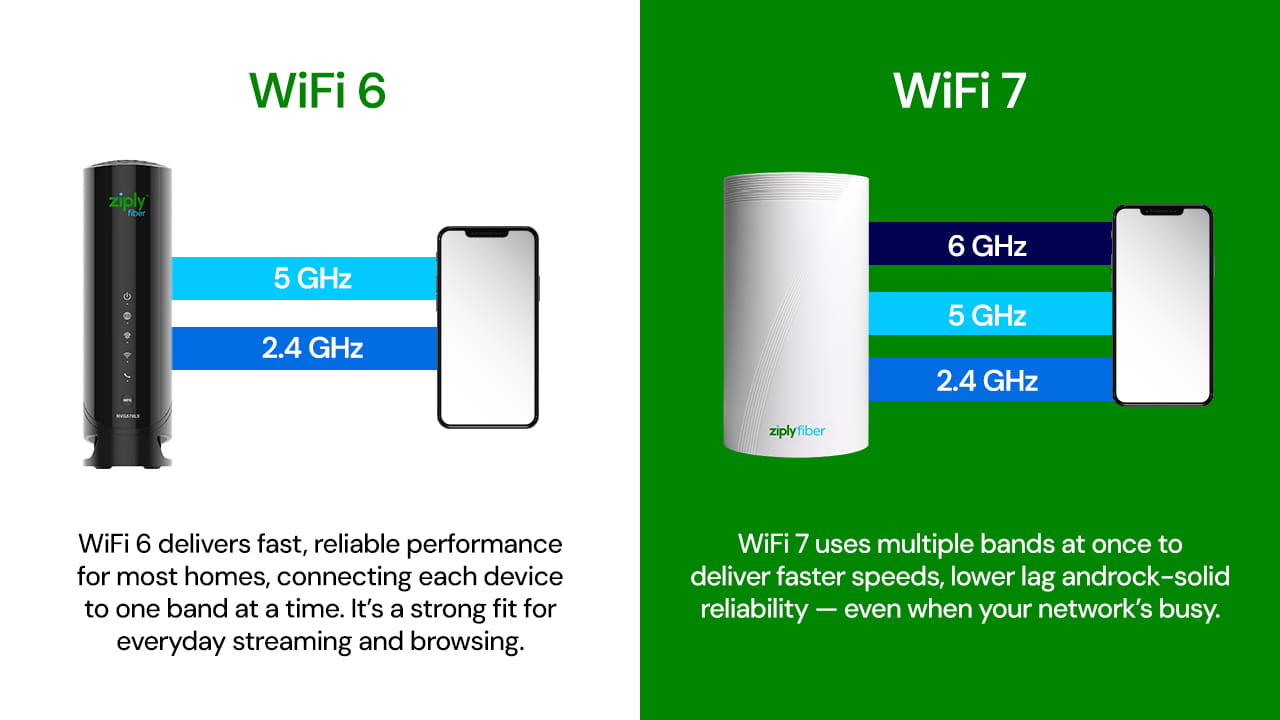
Whatever internet you have, be sure to use the router most optimized for that technology. For fiber internet, that's the WiFi 7 or WiFi 6 router. The WiFi 7 router is special because it utilizes three frequency bands, rather than two, and it can project wireless coverage further into the home. Your technician will be able to advise you on the best equipment. Note that unlike routers, modems and ONTs need to be installed by a professional.
Read more: What equipment is needed for fiber internet?
Ready to get started with fiber internet? Learn more about our installation process and fiber internet plans.
About the Author
Tom Novotney is part of Ziply Fiber's engineering and operations team, where he focuses on the technology and infrastructure that keep the Ziply Fiber network running smoothly.