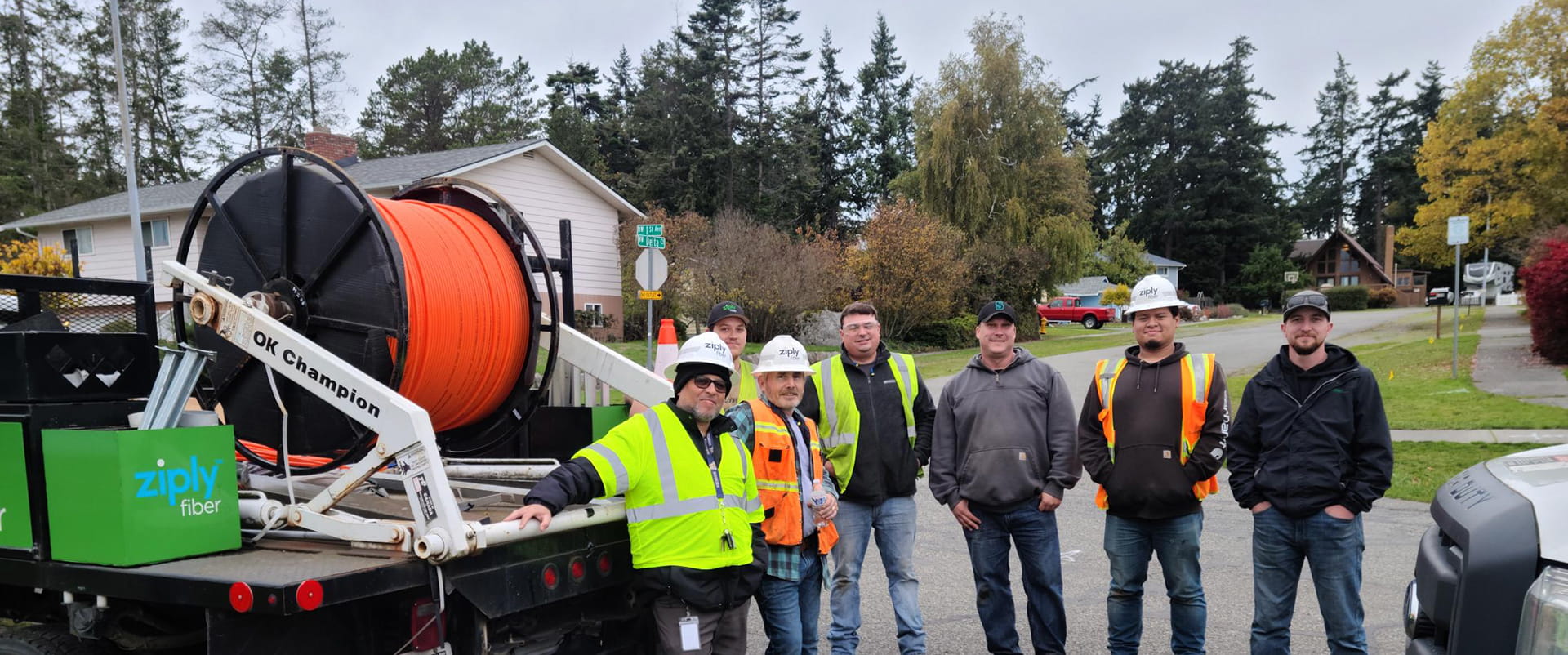

Before a single Ziply Fiber customer plugs in a router or runs a speed test, there’s a lot happening behind the scenes. Much of that work starts with Rob Larson and his Fiber Design and Construction team.
At a high level, Rob’s team helps decide where Ziply Fiber builds next and how those builds come to life. But as Rob is quick to point out, the work is about far more than maps, permits and construction plans.
“We set the Ziply Fiber build strategy into motion and determine how we’ll build the network that will change people’s lives,” Rob said. “We’re evaluating the areas, determining the network architecture and construction feasibility so we can execute our expansion strategy.”
What happens before customers ever see fiber internet
Long before Ziply Fiber service reaches a home or business, Rob’s team is deep in analysis mode. Every potential build starts with understanding the environment, both competitive and physical.
“There’s a great deal of planning and analysis that happens as we look at new places to build,” Rob explained. “We’re looking at what the competition is, the constructability, what the infrastructure looks like and the municipal requirements for each community.”
That work also includes navigating a complex web of requirements that vary from city to city.
“We’re sorting through pole attachment agreements, municipal codes, permit and franchising rules and design requirements,” he said. “There’s a lot of work that happens up front, and it involves a number of partners, including regulatory affairs, real estate, core transport, operations, marketing and meetings with cities.”
It is detailed, methodical work, and most customers will never see it. But it’s essential to making sure fiber internet arrives where it’s needed and arrives the right way.
Working with communities, not around them
One of the biggest challenges in building fiber networks is adapting to the unique rules and expectations of each community.
“Every city’s got their own rules and how they want to operate,” Rob said. “The biggest challenge is figuring out how you fit in that and adapt what you’re doing to that.”
For Rob, that mindset is not just practical. It’s foundational.
“The cities decide whether you get to build there,” he said. “You have to approach it that way, or you’re going to have delays in the build or challenges getting anything approved.”
That respect for local communities goes beyond permits and approvals. Rob sees Ziply Fiber as a long-term presence in the places it serves.
“There really shouldn’t be any place we’re building that we don’t want to be part of that community,” he said. “We see ourselves as changing people’s lives, and the internet actually creates our Ziply Fiber community.”
Balancing speed, quality and reliability
Building fast matters, but so does building well. Rob’s team balances those priorities by relying on strong standards and a consistent approach.
“You really have to have a certain set of standards that you always conform to and a standard architecture approach,” he said. “Since the beginning of Ziply Fiber, we agreed on how we’re going to size things and configure the network, from the customer’s home all the way back to where we connect to the internet.”
While every market has its quirks, Rob believes those shared standards help ensure long term reliability across the entire network.
“One of the things I’m most proud of is that we bring the same fiber network, America’s fastest internet, to every market we serve. Whether that’s a growing metro area or a small rural community, the standard doesn’t change. Everyone deserves access to the same quality connection.”
The people who thrive on the team
When it comes to building his team, Rob looks for more than technical skills. Passion and problem-solving sit at the top of the list.
“You have to be passionate about expanding fiber, creative enough to visualize multiple solutions and possess a belief in what the internet can do for people,” he said.
Just as important is the ability to think through challenges creatively.
“The ability to solve problems and to come up with solutions is what really makes people successful,” Rob said. “Everything’s an opportunity.”
Planners and engineers, he notes, have to be comfortable with constant change.
“As a planner, you have to look at everything from multiple angles,” he said. “You always have more than one plan.”
Rob jokes that he rarely stops at Plan B.
“I have a Plan A and a Plan B, and I haven’t told you about Plan C or D, but they’re there too,” he said.
For engineers, diversity of thinking is a strength.
“If you get three engineers in a room, they’re each going to come up with a way of doing things,” Rob said. “That’s awesome. But if you can find the engineer who comes up with all three of those ways, now you’ve got someone who’s going to be very successful.”
Looking ahead
What excites Rob most about the future is the scale of what his team is helping to build.
“We’re at the front end of the vision of where Ziply Fiber is going,” he said. “That couldn’t be more exciting.”
As Ziply Fiber continues expanding its network, that vision starts with planning and engineering.
“The entire company strategy, where we’re going, really starts with the planning and engineering team getting a rhythm to execute on that plan,” Rob said.
It is a responsibility Rob does not take lightly.
“As you think about changing people’s lives, that’s a big number of lives to change,” he said. “It’s a wonderful responsibility.”
If you’re interested in joining the Fiber Design and Construction team, or another team at Ziply Fiber, click here to view our current employment opportunities.