
Rob Vigil, VP, Fiber Design and Construction at Ziply Fiber
If you've ever shopped for internet service, you've probably run into the same comparison over and over: fiber vs. cable. They're often grouped together, and, on the surface, they can seem pretty similar. Both promise fast downloads, smooth streaming and enough bandwidth for modern households. But behind the scenes, fiber and cable are built very differently, and those differences show up in how your internet performs day to day.
What are we talking about here?
At the most basic level, both fiber-optic cable and cable are methods of delivering internet service from a provider's network to your home or business. The real distinction comes down to the type of cable used and how data travels through it. That may sound like a small technical detail, but it influences:
- How fast your internet can go
- How consistent it feels during busy times
- How well it can keep up with new technology and growing demand
Understanding this difference helps explain why two "fast" internet plans can feel very different in real life.
The technical definition (and what it really means)
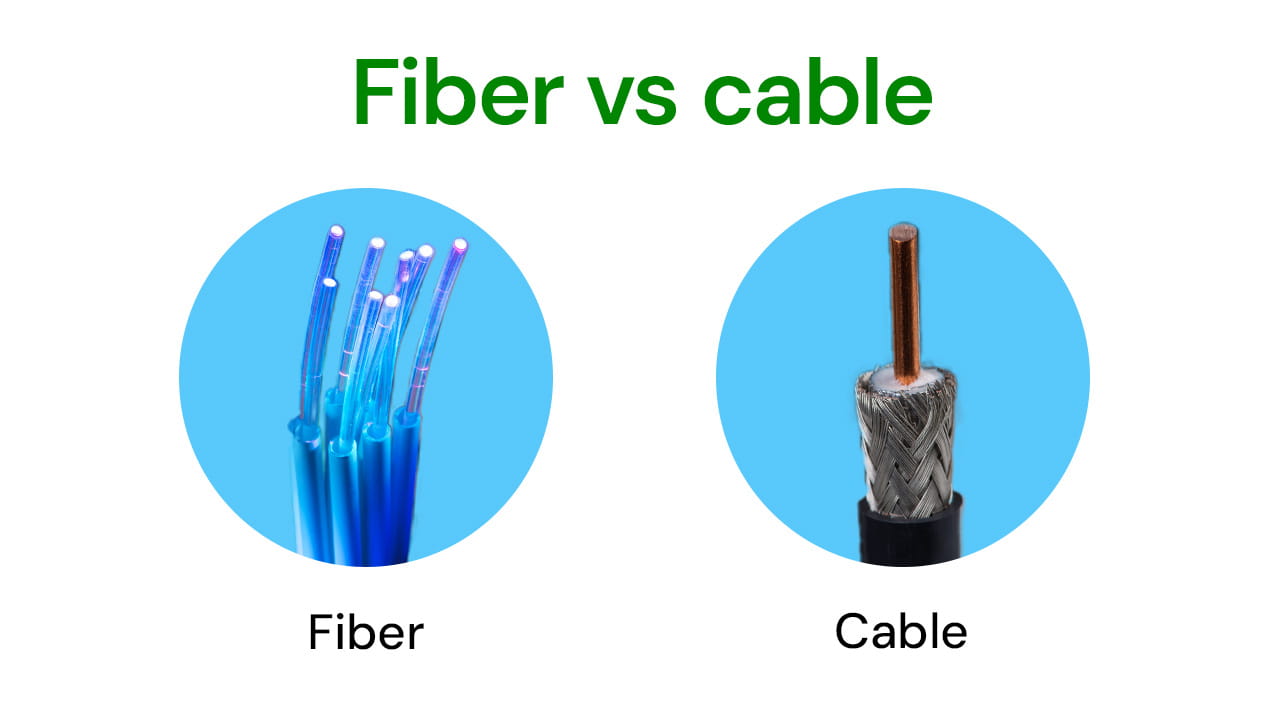
Fiber-optic internet uses extremely thin strands of glass or plastic, called fiber-optic cables, to transmit data as pulses of light.
Cable internet uses copper coaxial cables, originally designed to deliver cable television, to transmit data as electrical signals.
In plain terms:
- Fiber moves information using light.
- Cable moves information using electricity.
Light travels faster, carries more data and degrades less over distance than electrical signals. That's the core reason fiber-optic cables behave differently, even before you factor in speeds or pricing.
Why this difference matters
The way data moves through a network affects performance in several important ways. These are the differences most customers notice.
1. Speed (especially upload speed)
Cable internet is often marketed with strong download speeds, which work well for streaming and browsing. Upload speeds, however, are usually much slower.
Fiber-optic cable can support symmetrical speeds, meaning uploads are just as fast as downloads, but that capability only becomes reality when the network electronics and architecture are designed to support it. Not all fiber-based providers offer symmetrical speeds.
At Ziply Fiber, the network is purpose-built to take full advantage of fiber's potential, which is why symmetrical speeds are part of the experience. That difference becomes noticeable when you're:
- On video calls or virtual meetings
- Uploading photos, videos or large files
- Gaming online
- Backing up data to the cloud
As more everyday tasks require sending data, not just receiving it, upload speed becomes harder to ignore.
2. Reliability during peak usage
Cable internet is typically shared across a neighborhood. When many people are online at the same time, after work, on weekends or during major events, everyone draws from the same pool of bandwidth. That can lead to slower speeds or inconsistent performance during peak hours.
Fiber networks are designed differently. When paired with modern network architecture, fiber connections are far less affected by congestion, helping performance stay consistent even as demand increases.
3. Resistance to interference
Copper cables can be affected by electrical interference, weather conditions and signal degradation over distance. Fiber doesn't carry electricity, which makes it:
- Less vulnerable to interference
- More stable over long distances
- More reliable in a wider range of conditions
That stability is one reason fiber-based networks are often associated with fewer slowdowns and outages.
4. Built for the future
Cable technology has improved over time, but it's still pushing against the physical limits of copper. Fiber-optic cable offers far more headroom, but again, it's the network built around it that unlocks that potential.
With the right architecture, fiber networks can support:
- Faster speeds as technology advances
- Higher bandwidth demands
- New applications that haven't even hit the mainstream yet
Fiber isn't just faster today; when designed correctly, it's built to scale.
What fiber-optic networks enable you to do
When fiber-optic cable is paired with a modern, thoughtfully designed network, it delivers speed, consistency and capacity at the same time. That supports how people actually use the internet now, and how usage continues to evolve.
It makes it easier to:
- Work from home without dropped calls or lag
- Stream in high definition on multiple devices at once
- Use smart home technology reliably
- Upload and store content in the cloud quickly
- Share bandwidth across an entire household without slowdowns
Instead of planning your online activity around your connection, a well-built fiber network keeps up with you.
An analogy that makes it click
Think of cable internet like a busy neighborhood road. It works well most of the time, but during rush hour, traffic builds up. The more cars on the road, the slower everyone moves.
Now think of fiber-optic cable as the foundation for a high-speed rail system. The tracks allow for incredible speed and capacity, but it's the trains, signals and system design that determine how fast and smoothly everything runs.
Both will get you where you're going. One is built to move more people, more reliably, with far fewer delays.
The bottom line
Fiber-optic internet and cable internet may both fall under the "high-speed" umbrella, but they're built on very different foundations. Fiber's light-based technology, combined with the right network architecture, delivers faster uploads, more consistent performance and a network that's ready for what comes next. That's why fiber, when fully realized, is increasingly seen not just as an upgrade, but as the future of internet connectivity.
About the Author
Rob Vigil is part of Ziply Fiber's Design and Construction team, where he leads efforts that help build and expand the network our customers rely on every day.