

IP Transit is how regional ISPs, carriers and network operators move high volumes of customer traffic across the internet without building direct connections to every destination themselves.
The quality of that transit, including the peering relationships, backbone capacity, latency and routing intelligence, has a direct impact on the customer experience. With our IP Transit offering, you can move traffic on a 400G-ready backbone with 8 Tbps of edge-facing capacity and direct peering connections to major platforms and CDNs.
Traffic stays on our fiber as long as possible before handing off, meaning lower latency and fewer unnecessary hops. Pricing is straightforward. Route availability is transparent. And our wholesale team engages like they want your business.

With Ziply Fiber, you’ll have a partner that maintains direct peering connections to major platforms, content networks and CDNs. That means your traffic reaches its destination faster, with fewer hops and less dependence on the open internet.
Ziply Fiber's network runs 8 Tbps of edge-facing capacity. Traffic moves without congestion, so your customers won’t experience degraded performance during peak periods.


Our IP Transit keeps traffic on Ziply Fiber's 400G-ready backbone as long as possible before handoff. Less time on shared internet infrastructure means lower latency and more consistent performance for your end users.
With Ziply Fiber, you'll know what you're paying and what you're getting before you sign anything. Our IP Transit pricing doesn’t include any hidden port fees or complicated tiered structures.


Ziply Fiber maintains DDoS mitigation on our backbone network to help protect traffic across our infrastructure.
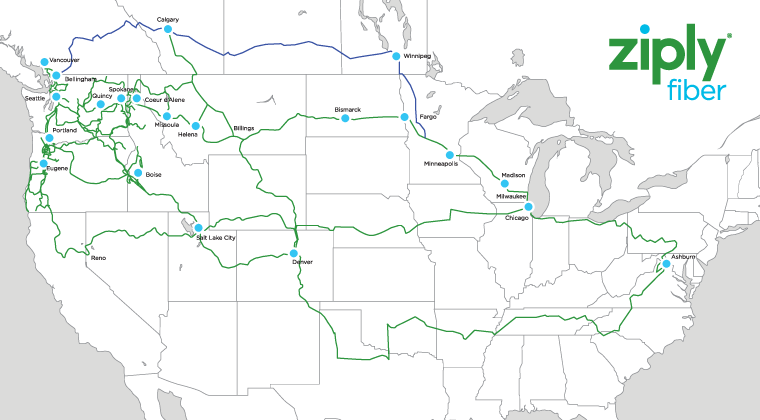
Ziply Fiber's network spans key markets from the West Coast to Chicago and Ashburn, with dense metro fiber rings across Seattle, Portland, Hillsboro, Boise and Spokane and a unique Northern Link Route reaching Minneapolis and Chicago. Salt Lake City, Denver and beyond are already on the map, and we're adding reach continuously.
Behind that footprint is a 400G-ready backbone with 8 Tbps of edge-facing capacity, extensive direct peering and at least three diverse routes into major backbone locations. Local routing and direct peering keep critical traffic in-region and off the open internet whenever possible

Scalable, standards-based Ethernet transport for carriers extending network reach and connecting locations.
LEARN MORE
Symmetrical, fiber-based dedicated internet access on a 400G-ready backbone. For buyers delivering dedicated internet capacity to their end users.
LEARN MORE

See the routes, markets and long-haul reach behind our IP Transit and transport products.
learn more